
Introduction
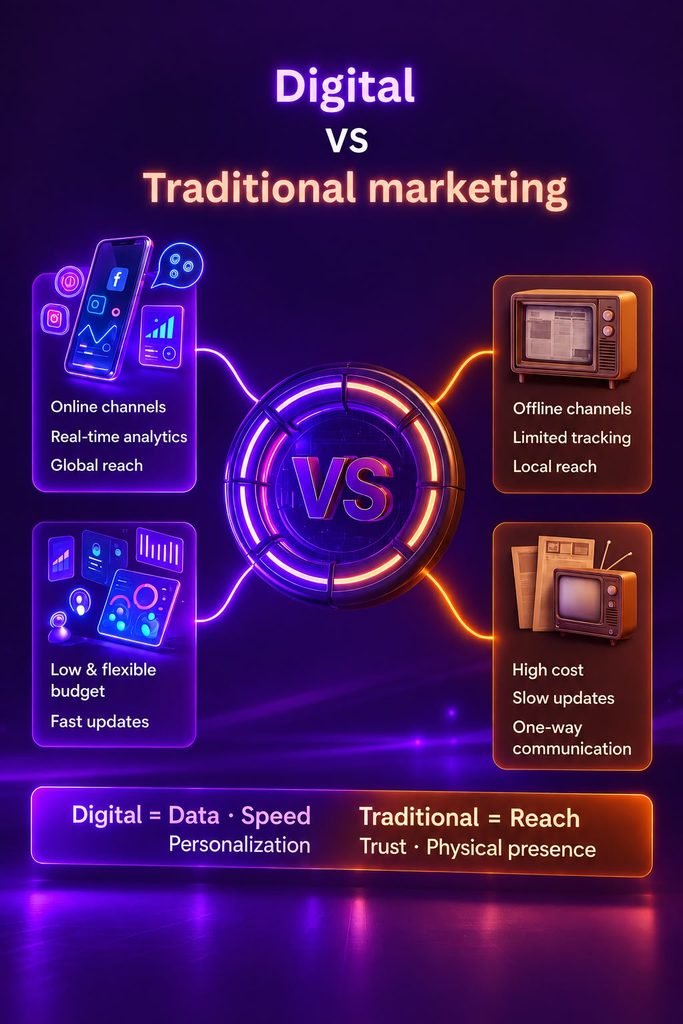
Marketing plays an important role in helping businesses attract customers, promote products, and build brand awareness. As technology continues to develop, businesses have more ways than ever to reach their target audience. Two major approaches are digital marketing and traditional marketing.
Traditional marketing uses offline channels such as newspapers, television, radio, billboards, and printed advertisements. Digital marketing uses online channels such as search engines, social media, websites, email, and digital advertising platforms.
Both approaches can help businesses grow, but they differ in cost, targeting, audience reach, measurement, and customer interaction.
In this blog, we will explore digital marketing vs traditional marketing, understand their key differences, compare their advantages and disadvantages, and discover how businesses can choose the right marketing strategy.
What Is Digital Marketing?
Digital marketing is the promotion of products, services, or brands through digital channels and technologies. It allows businesses to connect with potential customers online and measure how people interact with their marketing campaigns.
Popular types of digital marketing include:
- Search Engine Optimization (SEO): Improving website visibility in search engine results.
- Social Media Marketing: Promoting brands through platforms such as Instagram, Facebook, and LinkedIn.
- Search Engine Marketing (SEM): Using paid search advertising to reach people searching for relevant products or services.
- Content Marketing: Creating useful blogs, videos, guides, and other content.
- Email Marketing: Sending relevant messages and offers to subscribers.
- Pay-Per-Click Advertising (PPC): Running paid advertisements where costs may depend on clicks or other campaign settings.
- Influencer Marketing: Collaborating with relevant creators to promote products or services.
Example of Digital Marketing
A local restaurant can promote its menu through Instagram Reels, run Facebook and Instagram advertisements targeting nearby customers, and use Google Business Profile to help people discover its location.
These activities can increase online visibility and encourage customers to visit the restaurant or place an order.
What Is Traditional Marketing?
Traditional marketing refers to promotional activities carried out through offline media and established advertising channels. It has been used for decades to reach local communities, regional audiences, and large groups of consumers.
Common types of traditional marketing include:
- Newspaper and magazine advertisements
- Television commercials
- Radio advertisements
- Billboards and outdoor advertising
- Flyers and brochures
- Posters and banners
- Direct mail
- Event sponsorships and trade shows
Example of Traditional Marketing
A clothing store can distribute flyers around its neighbourhood, display banners outside the shop, and advertise a seasonal sale in a local newspaper.
These methods can help the business attract people who live nearby and may prefer offline information.
Digital Marketing vs Traditional Marketing: Key Differences
The main difference is the channel used to reach customers. However, each approach also differs in how audiences are targeted, how performance is measured, and how customers interact with a business.
| Factor | Digital Marketing | Traditional Marketing |
|---|---|---|
| Marketing channels | Websites, search engines, social media, email | TV, radio, newspapers, billboards |
| Audience targeting | Often allows detailed audience and behaviour-based targeting | Commonly targets audiences by location, publication, programme, or broad demographics |
| Cost | Can start with relatively small budgets | Some channels require substantial production and placement costs |
| Measurement | Offers metrics such as clicks, conversions, and engagement | Often relies on estimates, surveys, unique codes, or tracked responses |
| Interaction | Can support comments, messages, clicks, and online purchases | Often one-way, although customers can respond through calls, visits, or other methods |
| Optimization | Campaigns can often be adjusted quickly | Printed or broadcast campaigns may be harder to change after release |
| Reach | Can reach local or global audiences through online channels | Can reach local, regional, or national audiences depending on the medium |
| Personalization | Can tailor messages to different audience segments | Often uses broader messages for a particular audience |
| Speed | Campaigns can sometimes launch quickly | Production and placement may require more preparation |
| Best suited for | Online engagement, measurable campaigns, lead generation, e-commerce | Physical visibility, broad exposure, local awareness, offline audiences |
Actual results depend on the campaign, audience, industry, budget, and execution. Neither approach guarantees success.
Advantages of Digital Marketing
Digital marketing offers several benefits for businesses that want to reach customers online.
1. Precise Audience Targeting
Many digital advertising platforms allow businesses to define audiences using relevant criteria such as location, interests, or previous interactions, subject to platform policies and available settings.
For example, a fitness centre can promote its membership offers to people in its service area instead of advertising to an unnecessarily broad audience.
2. Flexible Budget Options
Businesses can often start with a small advertising budget and adjust spending based on campaign performance.
Organic channels such as SEO and social media content can also help businesses build visibility without paying for every individual view, although they still require time and resources.
3. Measurable Results
Digital platforms provide data that helps marketers understand campaign performance.
Common metrics include:
- Website traffic
- Impressions and reach
- Click-through rate
- Engagement rate
- Cost per lead
- Conversion rate
- Return on ad spend
These metrics help marketers identify opportunities for improvement.
4. Direct Customer Engagement
Customers can comment on posts, send messages, ask questions, and share their experiences online.
This interaction helps businesses understand customer needs and build stronger relationships.
5. Wider Market Reach
A business can use digital channels to reach people in a local area or expand into other regions and countries, depending on its products, services, and delivery capabilities.
Disadvantages of Digital Marketing
Despite its advantages, digital marketing also has some challenges.
- High competition: Many businesses compete for the same audience and search terms.
- Continuous learning: Platforms, advertising features, and search algorithms change over time.
- Content demands: Businesses need to create useful and engaging content consistently.
- Privacy requirements: Tracking and customer data collection must follow applicable laws and platform policies.
- Paid advertising costs: Competition can increase costs, and spending does not guarantee leads or sales.
- Trust challenges: Customers may be cautious about misleading advertisements, fake reviews, or poor-quality online experiences.
A clear strategy, accurate measurement, and consistent customer service can help businesses manage these challenges.
Advantages of Traditional Marketing
Traditional marketing remains useful for many businesses, especially when offline visibility and broad public exposure are important.
1. Strong Local Visibility
Billboards, shop signage, posters, and flyers can help businesses attract attention in specific physical locations.
For example, a new supermarket can display banners near nearby residential areas to promote its opening.
2. Reaches Offline Audiences
Not every potential customer regularly uses social media or searches online for products. Radio, print media, and outdoor advertisements can help reach people through other channels.
3. Physical Brand Presence
Printed brochures, product catalogues, and direct mail give customers something tangible to read or keep.
This can be useful for businesses that rely on in-person sales, events, or local relationships.
4. Broad Exposure
Television, radio, and large outdoor campaigns can expose a brand to many people within a region or market.
Their effectiveness depends on the audience, placement, timing, and quality of the message.
Disadvantages of Traditional Marketing
Traditional marketing also has limitations that businesses should consider.
- Potentially high costs: Television, radio, and premium print placements can require significant budgets.
- Limited targeting: Some offline channels reach broad audiences rather than narrowly defined customer groups.
- Difficult measurement: It may be harder to connect a particular advertisement directly to a sale.
- Slower changes: Printed materials and scheduled broadcasts can be difficult or expensive to update once production begins.
- Limited interaction: Many traditional advertisements provide fewer immediate opportunities for customers to engage directly with the brand.
These disadvantages vary by channel. For example, a small batch of local flyers may be inexpensive, while a national television campaign can be costly.
Digital Marketing vs Traditional Marketing: Which Is More Cost-Effective?
Cost-effectiveness depends on the business objective, target audience, industry, and campaign execution.
Digital marketing may be more suitable when a business wants to test different messages, generate trackable leads, reach specific audiences, or measure online conversions.
Traditional marketing may be valuable when a business wants strong local visibility, broad exposure, or access to audiences who are more responsive to offline media.
For example, a small business might use social media advertisements to generate enquiries while placing posters near its physical store to attract nearby customers.
Rather than comparing only the initial advertising cost, businesses should consider the total cost of acquiring a customer and the value that customer generates.
When Should Businesses Choose Digital Marketing?
Digital marketing may be a good choice when a business wants to:
- Generate online enquiries and leads.
- Increase website traffic through SEO.
- Promote products through social media.
- Run targeted advertising campaigns.
- Reach customers beyond its immediate location.
- Track campaign performance and conversions.
- Build an online brand presence.
- Sell products through an e-commerce website.
For businesses that depend on online discovery, digital marketing can provide useful tools for attracting and engaging potential customers.
When Should Businesses Choose Traditional Marketing?
Traditional marketing may be suitable when a business wants to:
- Promote a local store opening.
- Increase awareness through outdoor advertisements.
- Reach audiences who use print or broadcast media.
- Distribute printed product information.
- Promote a local event or community activity.
- Build physical visibility around a business location.
Businesses should choose traditional channels based on their customers’ media habits and the objectives of the campaign.
Can Digital Marketing and Traditional Marketing Work Together?
Yes. Combining both approaches can help businesses create a more consistent customer experience across online and offline channels.
This is often called integrated marketing.
For example, a restaurant could:
- Display promotional posters near its location.
- Run Instagram and Facebook advertisements for nearby customers.
- Add a QR code to printed materials that opens its menu or ordering page.
- Encourage customers to follow its social media accounts.
- Use a trackable offer code to measure responses from different campaigns.
A retail store could advertise a sale in a local newspaper and use digital advertising to remind interested customers about the offer.
The key is to maintain consistent branding, messaging, and offers across channels while measuring results wherever possible.
How to Choose the Right Marketing Strategy for Your Business
Before choosing between digital marketing and traditional marketing, consider the following factors.
1. Identify Your Marketing Goal
Decide whether you want to increase brand awareness, generate leads, increase sales, attract store visits, or retain existing customers.
2. Understand Your Target Audience
Find out where your potential customers spend their time and how they prefer to discover products and services.
3. Set a Realistic Budget
Estimate the costs of production, advertising placement, content creation, and ongoing campaign management.
4. Choose Relevant Channels
Select channels that match your goals. A local service business may prioritize search and social media, while an event organizer may also benefit from posters and community advertising.
5. Measure Performance
Track appropriate indicators, such as leads, enquiries, sales, store visits, coupon redemptions, or website conversions.
6. Improve Your Strategy
Use the results to improve your advertising messages, channel selection, budget allocation, and customer experience.
The best marketing strategy is the one that helps your business reach the right people and achieve measurable objectives.
Digital Marketing vs Traditional Marketing: Which Is Better?
Choosing between digital marketing vs traditional marketing depends on your business goals, target audience, and budget. Digital marketing vs traditional marketing offers different ways to promote products and services. While digital marketing helps businesses reach targeted audiences online, traditional marketing supports offline promotion through newspapers, television, flyers, and billboards. Understanding digital marketing vs traditional marketing helps businesses choose suitable marketing channels, improve brand awareness, and attract more customers.
Digital Marketing vs Traditional Marketing for Business Growth
Digital marketing vs traditional marketing plays an important role in business growth. Digital marketing helps businesses connect with customers through social media, search engines, websites, and online advertisements. Traditional marketing helps businesses reach audiences through newspapers, television, radio, and printed materials. By comparing digital marketing vs traditional marketing, businesses can understand which methods suit their budget, target audience, and marketing goals. Combining both approaches can help improve brand awareness and attract more customers.
Choosing Between Digital Marketing and Traditional Marketing
When comparing digital marketing vs traditional marketing, businesses should consider their target audience, budget, and marketing objectives. Digital marketing vs traditional marketing offers different benefits for reaching potential customers. Digital marketing supports online engagement, audience targeting, and performance tracking, while traditional marketing helps businesses build local awareness through offline channels. Understanding digital marketing vs traditional marketing can help businesses create an effective marketing plan, improve brand visibility, and attract the right customers.
Conclusion
Digital marketing and traditional marketing are both valuable ways to promote a business, but they serve different purposes.
Digital marketing provides online reach, interactive communication, and detailed performance data. Traditional marketing can offer strong physical visibility, broad exposure, and access to audiences through offline channels.
There is no single approach that is best for every business. The right choice depends on your goals, audience, budget, and industry.
For many businesses, combining digital and traditional marketing can create a stronger strategy. By understanding your customers, selecting the right channels, and measuring results, you can make better marketing decisions and support long-term business growth.
Frequently Asked Questions (FAQs)
1. What is the main difference between digital marketing and traditional marketing?
Digital marketing uses online channels such as websites, search engines, email, and social media. Traditional marketing uses offline channels such as television, radio, newspapers, flyers, and billboards.
2. Is digital marketing better than traditional marketing?
Neither is universally better. Digital marketing is often useful for online engagement and measurable campaigns, while traditional marketing can be effective for local visibility and broad offline exposure. The right choice depends on the business goal.
3. Which marketing method is cheaper?
Costs vary by channel and campaign. Digital marketing can allow businesses to start with smaller budgets, while some traditional channels require larger upfront investments. However, both methods can be cost-effective when planned well.
4. Can small businesses benefit from digital marketing?
Yes. Small businesses can use social media, local SEO, websites, and carefully managed paid campaigns to reach potential customers and build an online presence.
5. Is traditional marketing still effective?
Yes. Traditional marketing can still work well for local advertising, outdoor visibility, print campaigns, events, and audiences that respond to offline media.
6. Should a business use both digital and traditional marketing?
A business can combine both approaches when they support the same goals. For example, printed flyers can direct customers to a website, while digital ads can promote a local event.